Правила написания заголовков
Which words to capitalise in a title: the rules all styles share, where AP and Chicago differ, and how to convert a headline free in one click.
Опубликовано · Время чтения: 5 мин
In title case you capitalise the first and last words and every "major" word (nouns, verbs, adjectives, adverbs and pronouns), and keep short "minor" words like a, and, of, the and to lowercase. The style guides disagree mainly about prepositions: AP capitalises any word of four or more letters ("With", "From"), while Chicago keeps every preposition lowercase. The free case converter does the heavy lifting in one click; you then tidy a few edge cases by hand.
The rules every style agrees on
Whichever guide you follow, these hold:
- Capitalise the first word of the title, even if it's "a" or "the".
- Capitalise the last word, even if it's short: "What Are You Waiting For".
- Capitalise nouns, pronouns, verbs, adjectives and adverbs, however short. That includes little verbs and pronouns people often get wrong: Is, Be, Are, It, He, Its.
- Lowercase the articles a, an and the in the middle of a title.
- Lowercase the short coordinating conjunctions and, but, or and nor in the middle.
- Lowercase "to" when it's part of a verb, as in "How to Cook Rice".
So "why it is never too late to learn" becomes "Why It Is Never Too Late to Learn". Every word is capitalised except to, because It and Is are a pronoun and a verb.
Where AP and Chicago differ
| Question | AP style | Chicago style |
|---|---|---|
| Prepositions | Lowercase if three letters or fewer (in, on, at, for); capitalise four or more (With, From, Into, Over) | Lowercase all prepositions, whatever their length (with, from, through, between) |
| Conjunctions | Lowercase if three letters or fewer; capitalise four or more | Lowercase and, but, for, or, nor; capitalise others such as If, Because, Although |
| "As" | Lowercase (fewer than four letters) | Always lowercase |
A few titles written both ways:
| AP | Chicago |
|---|---|
| Gone With the Wind | Gone with the Wind |
| How to Deal With Stress at Work | How to Deal with Stress at Work |
| A Guide to Living Through the Winter | A Guide to Living through the Winter |
| The Case for Working From Home | The Case for Working from Home |
One more thing about AP: news organisations that follow AP usually write their headlines in sentence case ("Rain expected across the north tomorrow") and keep title case for the names of books, films, songs and other works. Blogs and businesses that say "AP title case" generally mean the four-letter rule above.
APA style, common in academic papers, uses a rule close to AP's: capitalise words of four letters or more, plus all major words, and lowercase minor words of three letters or fewer.
The tricky cases
Phrasal verbs. In "Log In to Your Account", In is part of the verb "log in", not a preposition, so it's capitalised in both styles. Likewise "Set Up", "Back Up", "Turn Off".
Hyphenated words. Capitalise the main parts: "Well-Known", "Long-Term", "Self-Driving". Chicago keeps articles, prepositions and short conjunctions inside a compound lowercase, as in "State-of-the-Art", and most writers follow the same habit.
Subtitles. Chicago and APA treat the first word after a colon as the start of a subtitle and capitalise it, and most writers do the same: "Travel Guide: The Best Beaches in Goa".
Acronyms and brand names. Keep them as they are: "CV", "NASA", "PDF", "iPhone".
Numbers. A title can start with a numeral, as in "10 Tips for Writing a CV That Gets Noticed". That is a pronoun here, so it's capitalised.
How the case converter handles title case
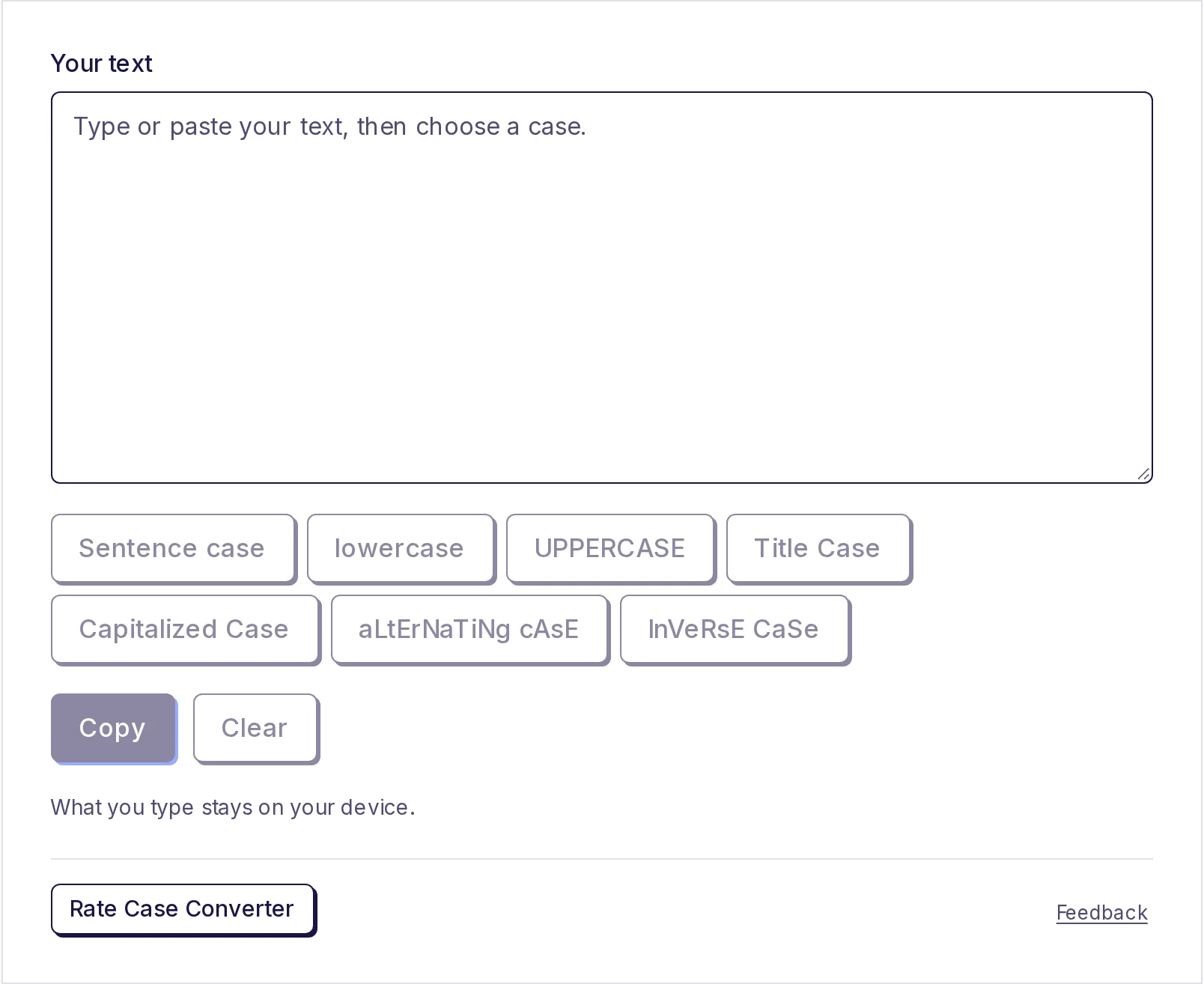
Paste your title into the free case converter and click Title Case. It:
- capitalises the first and last word of each line;
- keeps these short words lowercase in the middle: a, an, and, as, at, but, by, en, for, if, in, nor, of, on, or, per, the, to, v, vs, via;
- capitalises every other word, including both parts of hyphenated words.
That list lines up closely with AP-style titles: "with", "from" and "into" are capitalised. For Chicago, lowercase any longer prepositions afterwards.
Because it lowercases the text first, check these by hand after converting:
- Acronyms come out as "Cv", "Nasa" or "Pdf". Put the capitals back.
- The word after a colon stays lowercase if it's a minor word ("Guide: the Best"). Capitalise it.
- Phrasal verbs such as "Log in" keep the small word lowercase. Capitalise it if it's part of the verb.
- Hyphenated phrases such as "State-Of-The-Art" get every part capitalised. Lowercase the small words inside.
For most everyday headlines none of these come up, and one click is all you need. If you'd rather capitalise every single word, use Capitalized Case instead.
Title case or sentence case?
Many websites, apps and news sites now prefer sentence case for headings: only the first word and names are capitalised. It's easier to apply consistently and reads a little less formally. Title case still suits book and film titles, formal reports, and brands that already use it. Pick one and use it everywhere on the same page or document.
If you're fixing text that came in all capitals rather than writing a title, see how to change text to uppercase or lowercase. And if your headline has to fit a limit, such as about 60 characters for a page title in search results, check it with the free character counter, or see the social media character limits guide.
Convert your title now
Paste your headline into the free case converter, click Title Case, then fix any acronyms or subtitles. Your text stays on your device.
Частые вопросы
- Вопрос: words are not capitalised in a title?
- Articles (a, an, the), short coordinating conjunctions (and, but, or, nor) and short prepositions (in, on, at, to, of), unless they're the first or last word. Chicago also lowercases longer prepositions such as with and through.
- Вопрос: "with" capitalised in a title?
- In AP style, yes, because it has four letters. In Chicago style, no, because Chicago lowercases all prepositions.
- Вопрос: "is" be capitalised in a title?
- Yes. Is is a verb, and verbs are always capitalised in title case, however short.
- Вопрос: you capitalise the word after a colon in a title?
- Usually, yes: Chicago and APA capitalise the first word of a subtitle, and most writers follow suit. The case converter leaves a short word after a colon lowercase, so fix it by hand.
- Вопрос: is the difference between title case and sentence case?
- Title case capitalises every major word. Sentence case capitalises only the first word and proper names, like a normal sentence.
Инструменты для текста
Попробуйте Изменить регистр текста
Бесплатно, без регистрации, работает в браузере. Вставьте текст и одним нажатием переведите его в ПРОПИСНЫЕ, строчные, «Как в предложении», «Как В Заголовке» или «Каждое Слово С Заглавной», а затем скопируйте.
Также пригодится
- Счётчик словВставьте или введите текст, чтобы по мере ввода считать слова, символы (с пробелами и без), предложения и абзацы, а также время чтения, время произнесения и самые частые слова. Ничего не нужно нажимать: числа обновляются сразу. Всё, что вы вводите, остаётся на вашем устройстве.
- Счётчик символовСчитайте символы с пробелами и без прямо во время ввода и смотрите, сколько осталось до лимита постов в X, SMS, метаописаний, описаний профиля в Instagram, LinkedIn, YouTube и вашего собственного лимита. Также считаются пробелы, буквы, строки и байты.