ChatGPT API Cost per Word: Prices per 1,000 Words
The ChatGPT API bills per token, not per word. Turn per-million-token prices into cost per 1,000 words, with worked examples and a free token counter.
Published · 5 min read
The ChatGPT API cost is set per million tokens, and in English 1,000 words is roughly 1,350 tokens. So the cost per 1,000 words is about 1.35 × the per-million price ÷ 1,000. With GPT-5 listed at $1.25 per million input tokens and $10 per million output tokens, that's about $0.0017 to send 1,000 words and $0.0135 to get 1,000 words back. Count your real text with the free AI token counter to replace the estimate with an exact figure.
The ChatGPT app and the API are billed differently
It helps to separate two things people both call "ChatGPT":
- The ChatGPT app (chat in a browser or phone) has a free plan and flat-fee subscriptions. You don't pay per word there.
- The OpenAI API, which developers use to build ChatGPT-style features into their own apps, charges for every token sent and received.
Everything below is about the API. If you only use the chat app, tokens still matter for how much text a model can take in, but they don't appear on a bill.
The formula: tokens to cost per word
API prices are quoted per million tokens, with separate rates for input (your prompt) and output (the model's reply). To get cost per 1,000 words:
- Convert words to tokens. For everyday English prose, multiply words by about 1.35. Code, numbers and non-English text need more.
- Multiply by the price per token, which is the per-million price ÷ 1,000,000.
Cost of 1,000 words = 1,000 × 1.35 × price per million ÷ 1,000,000
Worked example with GPT-5 output at $10 per million: 1,000 × 1.35 = 1,350 tokens. 1,350 × 10 ÷ 1,000,000 = $0.0135, or about 1.35 cents for 1,000 words of reply.
The 1.35 ratio is a planning number. Our explainer on how many words is 1,000 tokens shows how it shifts by type of text, and what tokens are in AI explains why.
ChatGPT API cost per 1,000 words by model
These use OpenAI's listed standard prices, as per OpenAI's API pricing page, October 2026, and the 1.35 tokens-per-word estimate:
| Model | Input $/1M tokens | Output $/1M tokens | Send 1,000 words | Receive 1,000 words |
|---|---|---|---|---|
| GPT-5 | $1.25 | $10.00 | $0.0017 | $0.0135 |
| GPT-5 mini | $0.25 | $2.00 | $0.0003 | $0.0027 |
| GPT-4.1 | $2.00 | $8.00 | $0.0027 | $0.0108 |
| GPT-4o mini | $0.15 | $0.60 | $0.0002 | $0.0008 |
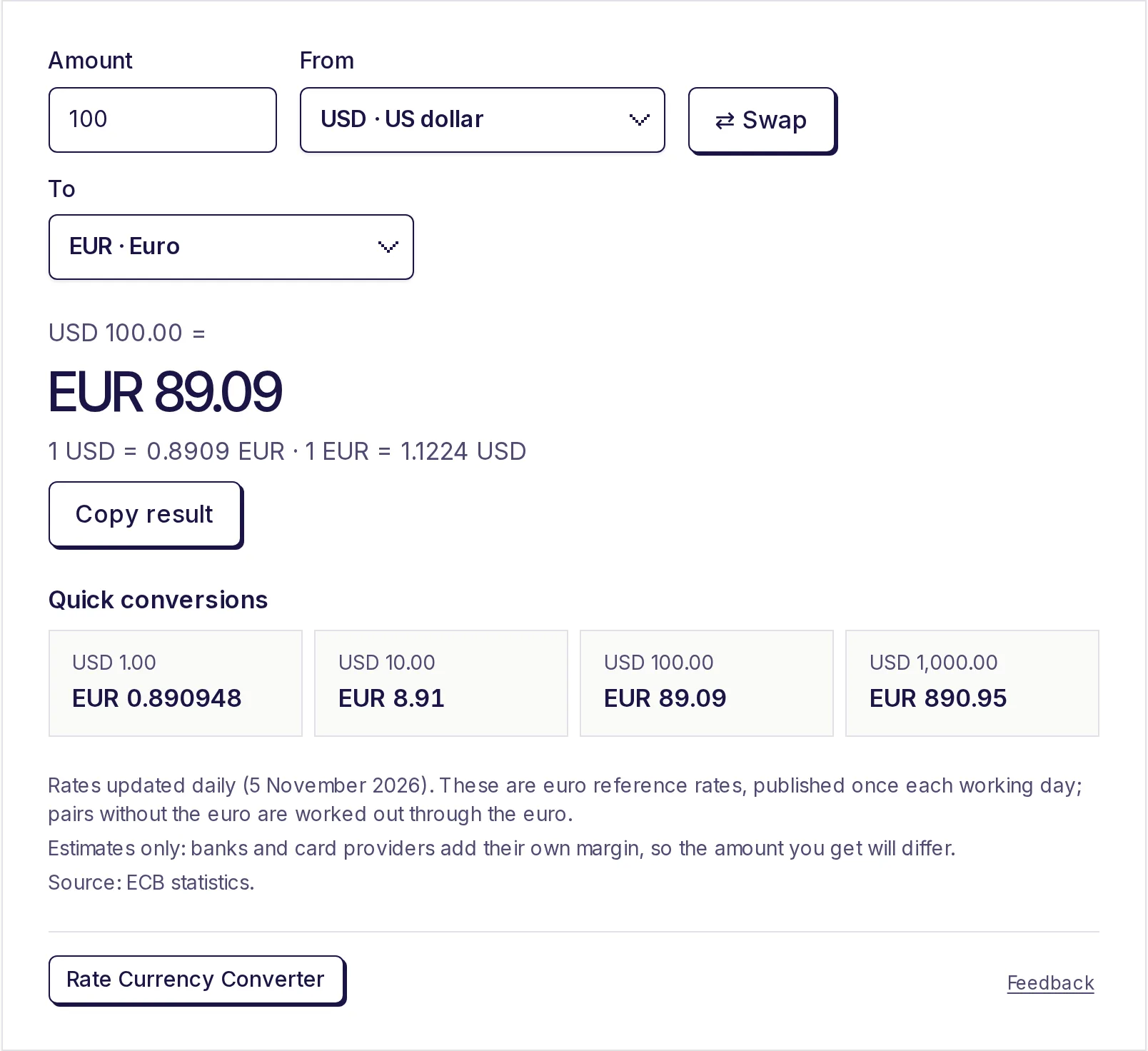
Prices change often. OpenAI now lists GPT-5, GPT-4.1 and GPT-4o as deprecated, and its newer models are priced differently, some higher per token and some lower. Treat the table as a worked example of the method and check the current pricing page before you budget. To see the figure in rupees or another currency, multiply by the day's rate in the currency converter.
Why output costs more than input
On every model in the table, a word the model writes costs four to eight times as much as a word you send. Two practical consequences:
- Ask for shorter answers. "Reply in under 100 words" or "return only the JSON" cuts the expensive side of the bill.
- Don't fear long context too much. Pasting a 5,000-word report into GPT-5 for a 300-word summary is about 6,750 input tokens and 405 output tokens: roughly $0.0084 plus $0.0041, or about 1.25 cents in total.
Some models also offer a lower price for cached input, when the start of your prompt is identical to a recent request. Long instructions that never change benefit most.
A worked monthly budget
Say a support bot answers 1,000 questions a day on GPT-5 mini. Each request sends 400 words (250 words of fixed instructions plus the customer's message) and gets back a 200-word answer.
- Input: 400 × 1.35 = 540 tokens × $0.25 per million = $0.000135
- Output: 200 × 1.35 = 270 tokens × $2.00 per million = $0.00054
- Per request: about $0.000675
- Per day (1,000 requests): about $0.68
- Per 30-day month: about $20
Run the same traffic on GPT-5 and the month comes to about $101. The model you pick moves the bill far more than trimming a few words. Notice too that the fixed 250-word instructions alone are over 10 million input tokens a month; that's where caching or a tighter prompt pays off.
Hidden token costs to plan for
- Conversation history. In a chat, earlier messages are usually sent again with each new question, so the input grows every turn.
- Message formatting. Each chat message adds a few tokens for roles and structure.
- Reasoning tokens. Some models "think" before answering, and that thinking is billed as output even though you don't see it. Check how the model you use reports it.
- Non-English text and code. Both use more tokens per word, so the 1.35 ratio can be too low. A Hindi sentence can take more than twice the tokens of its English translation on older tokenizers.
Measure instead of guessing
The 1.35 rule is good for a rough budget. For real numbers, paste a typical prompt and a typical reply into the free AI token counter:
- Paste your text or open a text file (up to 10 MB).
- Read the exact count for GPT-5, GPT-4.1, GPT-4o, which share one tokenizer, or GPT-4, GPT-3.5 Turbo, which share another.
- Multiply input tokens by the input price and output tokens by the output price, then by your monthly request volume.
The counter covers the tokenizers OpenAI has published for those families; newer models may tokenize slightly differently, so leave some headroom. Our guide on counting tokens for ChatGPT and Claude covers Claude and Gemini estimates too, and the context window explainer covers length limits.
Work out your cost now
Paste a real prompt into the free AI token counter, note the token count, and multiply by the current price per million. It's free, needs no account, and your prompt never leaves your device.
Frequently asked questions
- How much does the ChatGPT API cost per word?
- At GPT-5's listed prices (October 2026), about $0.0000017 per word sent and $0.0000135 per word received, based on 1.35 tokens per English word. Cheaper models such as GPT-5 mini cost about a fifth of that.
- How many tokens is 1,000 words?
- About 1,300 to 1,400 tokens for typical English prose. Code, numbers, tables and non-English text use more, so measure your own text with a token counter.
- Is the ChatGPT Plus subscription charged per token?
- No. The chat app's plans are flat-fee. Per-token billing applies to the OpenAI API, which developers use in their own apps.
- Why is output more expensive than input?
- Generating each token takes the model more work than reading one, so providers price output several times higher. Asking for shorter replies is the simplest way to save.
- Do spaces and punctuation cost money?
- They're part of the tokens, so yes, in a small way. A space is usually merged into the next word's token, while punctuation and line breaks can be tokens of their own.
Text tools
Try the AI Token Counter
Free, no sign-up, and your files stay on your device. Paste a prompt or document to count its tokens as you type: exact counts for GPT-5, GPT-4.1, GPT-4o and GPT-4, plus estimates for Claude and Gemini, and how much of each model's context window it fills.
Also useful
- Word CounterPaste or type your text to count words, characters (with and without spaces), sentences and paragraphs as you type, plus reading time, speaking time and your most used words. Nothing to click: the numbers update live. What you type stays on your device.
- Currency ConverterConvert between US dollars, euros, pounds, rupees, yen and about 30 other currencies using the official euro reference rates, updated every working day. Type an amount and see the result straight away, with the rate both ways.