How Long Should a Blog Post Be? Word Counts by Post Type
There's no magic length. Most useful posts run 800-2,000 words depending on the type. See ranges by post type and check yours with a free word counter.
Published · 5 min read
A blog post should be as long as it takes to answer the reader's question fully, and no longer. In practice, most useful posts land between 800 and 2,000 words: a quick news update or tip can be 300-600 words, a how-to guide 1,000-1,500, and an in-depth guide 2,000 or more. Paste your draft into the free word counter to see the word count, paragraphs and reading time as you edit.
Is word count a Google ranking factor?
No, not by itself. Google's own guidance on creating helpful content lists this as a warning sign of writing for search engines instead of people: "Are you writing to a particular word count because you've heard or read that Google has a preferred word count? (No, we don't.)" (Google Search Central, helpful content guidance, 2026).
Longer posts often do rank well, but that's usually because they cover a topic more completely, answer follow-up questions and earn more links, not because of the number at the bottom of the editor. A 2,500-word post padded with a long introduction can do worse than a tight 900-word one that answers the question in the first paragraph.
So the useful question isn't "how many words?" but "what does the reader need to finish their task?"
Typical length by post type
These ranges come from common publishing practice, not from any rule. Use them as a starting point, then cut or expand to fit the topic.
| Post type | Typical length | Reading time at 240 wpm |
|---|---|---|
| News update, announcement | 300-600 words | 1-3 min |
| Quick tip or answer post | 500-900 words | 2-4 min |
| How-to guide with steps | 1,000-1,500 words | 4-6 min |
| List post ("9 ways to...") | 1,000-2,000 words | 4-8 min |
| Comparison or review | 1,500-2,500 words | 6-10 min |
| In-depth guide or pillar page | 2,500-4,000+ words | 10-17 min |
| Personal essay or opinion | 800-1,500 words | 3-6 min |
The reading times use the same speed as the word counter: 240 words a minute, a common estimate for adults reading on screen. A 1,200-word post shows as a 5-minute read.
How long should a blog post be for your topic?
- Search the question yourself. Look at the top few results. If they're all short answers, a 3,000-word post is probably overkill. If they're all detailed guides, 500 words won't be enough to compete.
- List what the reader needs. Write down the questions someone would ask: what is it, how do I do it, what can go wrong, what does it cost. Each one is a section. The length falls out of the list.
- Answer first. Put the direct answer in the first paragraph, then add detail. Readers who only want the answer get it fast; readers who want more keep going.
- Cut what doesn't help. History nobody asked for, repeated points and "in this article we will" intros all add words without adding value.
- Check the numbers. Paste the draft into the free word counter and look at the totals.
What the word counter shows you
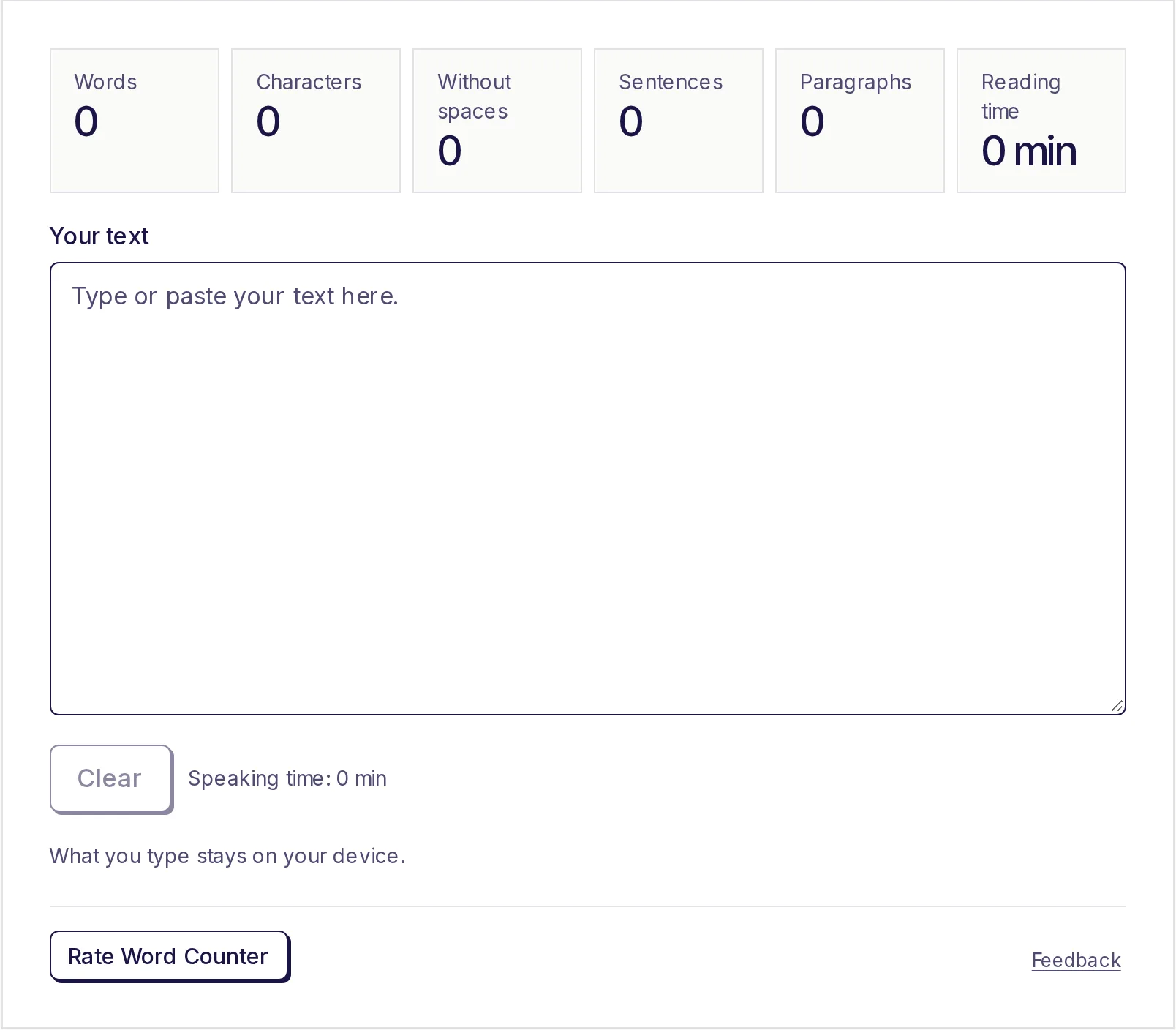
The word counter updates as you type or paste:
- Words, Characters and characters Without spaces.
- Sentences and Paragraphs, useful for spotting walls of text.
- Reading time, based on 240 words a minute.
- Speaking time under the text box, based on 130 words a minute, handy if you're turning the post into a video or podcast script.
- Most used words, which shows when you've leaned on the same word too often.
Everything happens in your browser; your draft is never uploaded. That matters if you're working on an unpublished post for a client.
Paragraph and sentence length matter more than total length
A long post is easy to read if it's broken up well. A short post can still feel heavy if it's one block of text. A few habits help:
- Keep most paragraphs to 2-4 sentences on the web. On a phone, a 6-sentence paragraph fills the whole screen. See how many words are in a paragraph for typical ranges.
- Aim for an average sentence of 15-20 words. Divide the word count by the sentence count from the counter to check.
- Use H2 subheadings every 200-300 words so skimmers can find their section.
- Use numbered steps for processes and tables for comparisons.
The parts around the post have limits too
Some parts of a blog post do have practical lengths, because search results and social apps cut them off:
- Title: roughly 50-60 characters before it gets cut off in search results.
- Meta description: roughly 150-160 characters. The guide on meta description length explains why it's measured in pixels rather than a fixed count.
- URL slug: a few words, lowercase, with hyphens. See URL slug best practices.
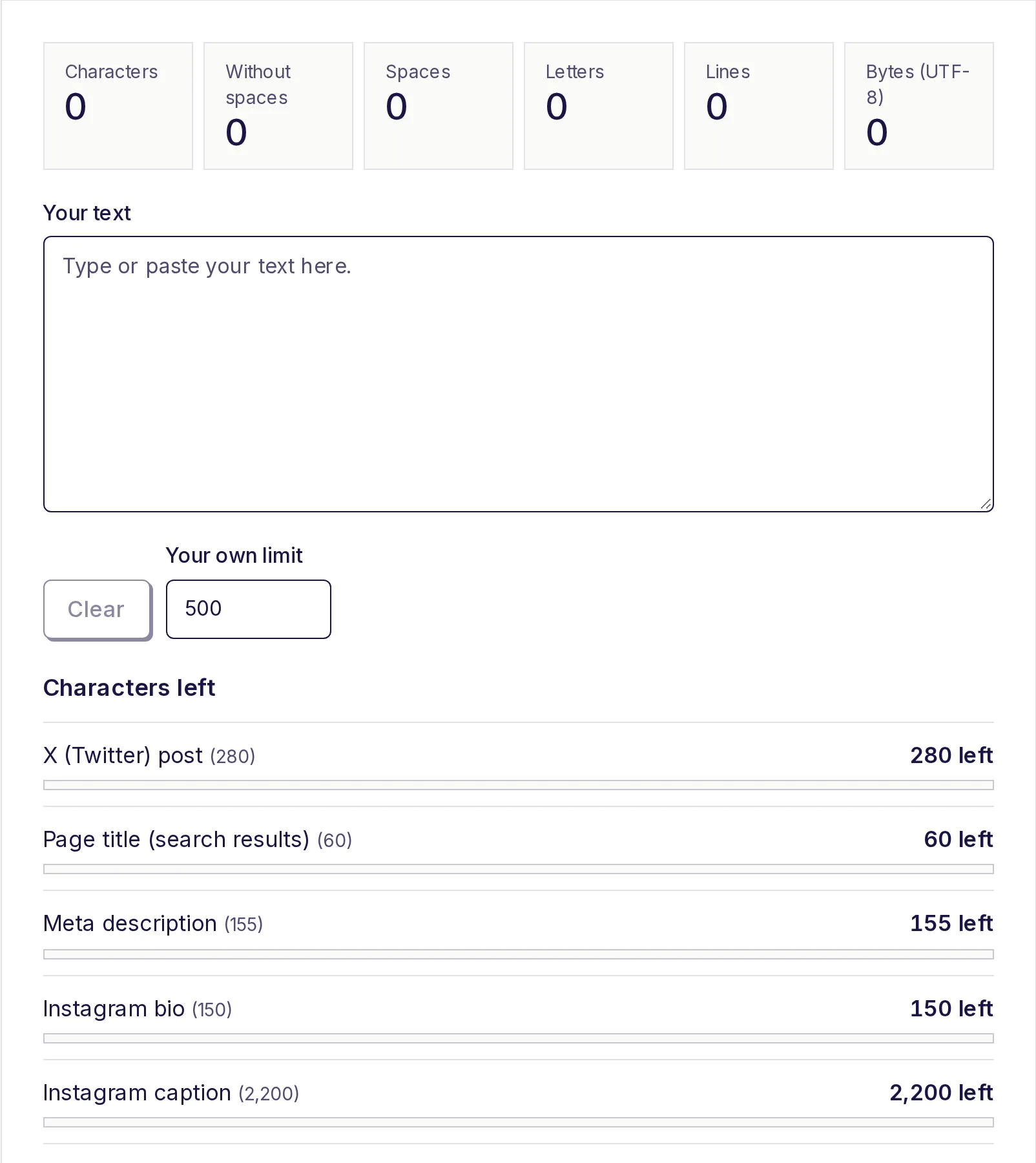
For these, the free character counter is quicker than counting words, because it shows how many characters you have left.
When to go longer, and when to stop
Go longer when the topic has many steps, the reader is making a decision with money or health involved, or the post is meant to be the one page someone bookmarks. Long guides work best with a short table of contents near the top.
Stop when you've answered the question, covered the common follow-ups and given the next step. If you're adding a paragraph only to reach a number, it's finished. If you need to trim, the tips in how to reduce word count help you cut without losing meaning. If you're short and the post feels thin, how to increase word count honestly covers adding examples and counterpoints rather than filler.
Check your draft now
Paste your post into the free word counter to see its words, paragraphs and reading time, then compare it with the ranges above. It's free, needs no sign-up, and your text stays on your device.
Frequently asked questions
- What is the ideal blog post length for SEO?
- There isn't one. Google says it has no preferred word count. Write enough to fully answer the search, which for most how-to topics is about 1,000-1,500 words.
- Is 500 words enough for a blog post?
- Yes, for a news update, a quick tip or a simple answer. For a detailed how-to or comparison, 500 words usually leaves out steps readers need.
- How long does it take to read a 1,000-word blog post?
- About 4 minutes at 240 words a minute, the speed the word counter uses. Slower readers or technical topics take longer.
- Do longer blog posts get more traffic?
- Often, but because they tend to cover a topic more fully and attract links, not because of length itself. A padded long post can perform worse than a focused short one.
- How many words should a blog introduction be?
- Usually 40-100 words. Give the answer or the promise of the post quickly, then move on to the first section.
Text tools
Try the Word Counter
Free, no sign-up, works in your browser. Paste or type your text to count words, characters (with and without spaces), sentences and paragraphs as you type, plus reading time, speaking time and your most used words.