How Many Words Is 1,000 Tokens? English, Hindi and Code
About 750 English words is the usual rule, but it ranges from roughly 550 to 880 by writing style, and Hindi and code use more tokens. Measure your own free.
Published · 5 min read
1,000 tokens is about 750 English words by the usual rule of thumb (1 token ≈ 0.75 words). It ranges from roughly 550 words for dense technical writing to nearly 900 for simple everyday prose. Other languages, code and data use more tokens per word: Hindi can need several times more on older tokenizers. To convert tokens to words for your own text, paste it into the free AI token counter, which shows words and tokens side by side.
The rule of thumb, and where it comes from
Language models split text into tokens: common words are usually one token, longer or rarer words are two or more pieces, and punctuation and spaces get absorbed along the way. Averaged over a lot of ordinary English, that comes out at about 4 characters per token and 0.75 words per token. So:
- 1,000 tokens ≈ 750 words
- 1,000 words ≈ 1,000 ÷ 0.75 ≈ 1,333 tokens
Our guide on counting tokens for ChatGPT and Claude explains these basics. This page is about why your text may come out quite differently.
We measured: it depends on the text
We ran short samples through the GPT-4o tokenizer (the one GPT-5 and the o-series also use) and the older GPT-4 tokenizer, and worked out how many words 1,000 tokens would hold at each rate:
| Sample | Words per 1,000 tokens (GPT-4o / GPT-5) | Words per 1,000 tokens (GPT-4) |
|---|---|---|
| Simple everyday English (a short story about a bus ride) | about 880 | about 880 |
| Formal English (a legal indemnity clause) | about 750 | about 750 |
| Technical English (a paragraph on photosynthesis) | about 550 | about 530 |
| Spanish (a translation of part of the bus story) | about 870 | about 730 |
| Hindi (a translation of part of the bus story) | about 700 | about 210 |
| JavaScript code (counted as space-separated pieces) | about 510 | about 520 |
These are small samples, so treat them as an illustration of the spread, not fixed rates. The pattern is reliable though:
- Plain words are cheap. Short, common words like "bus", "every", "morning" are single tokens.
- Long and specialised words are expensive. "Ribulose-1,5-bisphosphate" breaks into many pieces.
- Legal English sits right on the 750 rule because it mixes common words with longer formal ones.
Why Hindi uses more tokens
Tokenizers learn their vocabulary mostly from text on the web, which is heavily English. Words in other scripts are less likely to be single tokens, so they get split into smaller pieces.
The difference between tokenizers is large. Our Hindi sample of 79 words was 113 tokens on the GPT-4o tokenizer but 376 on the older GPT-4 one, more than three times as many. Other Indian languages and many non-Latin scripts tend to follow the same pattern: newer tokenizers with bigger vocabularies handle them much better, but they usually still need more tokens per word than English.
What this means in practice:
- A prompt in Hindi costs more tokens, and so more money on pay-per-token APIs, than the same prompt in English.
- A context window holds fewer Hindi words than English words.
- Using a newer model can cut the token count sharply for the same text.
Claude and Gemini use their own tokenizers, which aren't published for offline use, so the counter estimates them. Expect the real numbers to differ, especially for non-English text.
Code and data
Code doesn't really have "words", so a characters-per-token view is more useful. Brackets, operators, indentation and line breaks all take tokens. Our small JavaScript function used about 2 tokens per space-separated piece.
JSON is similar: a small object like {"name": "Asha", "age": 29, ...} came to about 3 tokens per "word". Minifying JSON removes indentation tokens; one formatted record dropped from 124 tokens to 74 when minified. See how to minify JSON.
Quick tokens to words conversions (English)
At 0.75 words per token, rounded:
| Tokens | About this many English words | Roughly |
|---|---|---|
| 100 | 75 | A short paragraph |
| 500 | 375 | A long email |
| 1,000 | 750 | 1.5 pages single-spaced |
| 4,000 | 3,000 | A long article |
| 32,000 | 24,000 | A short book or long report |
| 128,000 | 96,000 | A full-length novel |
For your actual text, measure: a technical document might hold only two-thirds of these word counts, a chatty one a little more. For what the larger numbers mean for an AI's memory, see context windows explained.
Measure your own text
- Open the free AI token counter.
- Paste a representative chunk of your text (a few paragraphs is enough) into Your text or prompt.
- Note the words under the box and the token count for the model family you use.
- Divide: words ÷ tokens × 1,000 = words per 1,000 tokens for your kind of writing.
- Use that rate to estimate longer documents, or just paste the whole thing; it counts files up to 10 MB.
For example, if 420 words come to 500 tokens, your rate is 420 ÷ 500 × 1,000 = 840 words per 1,000 tokens.
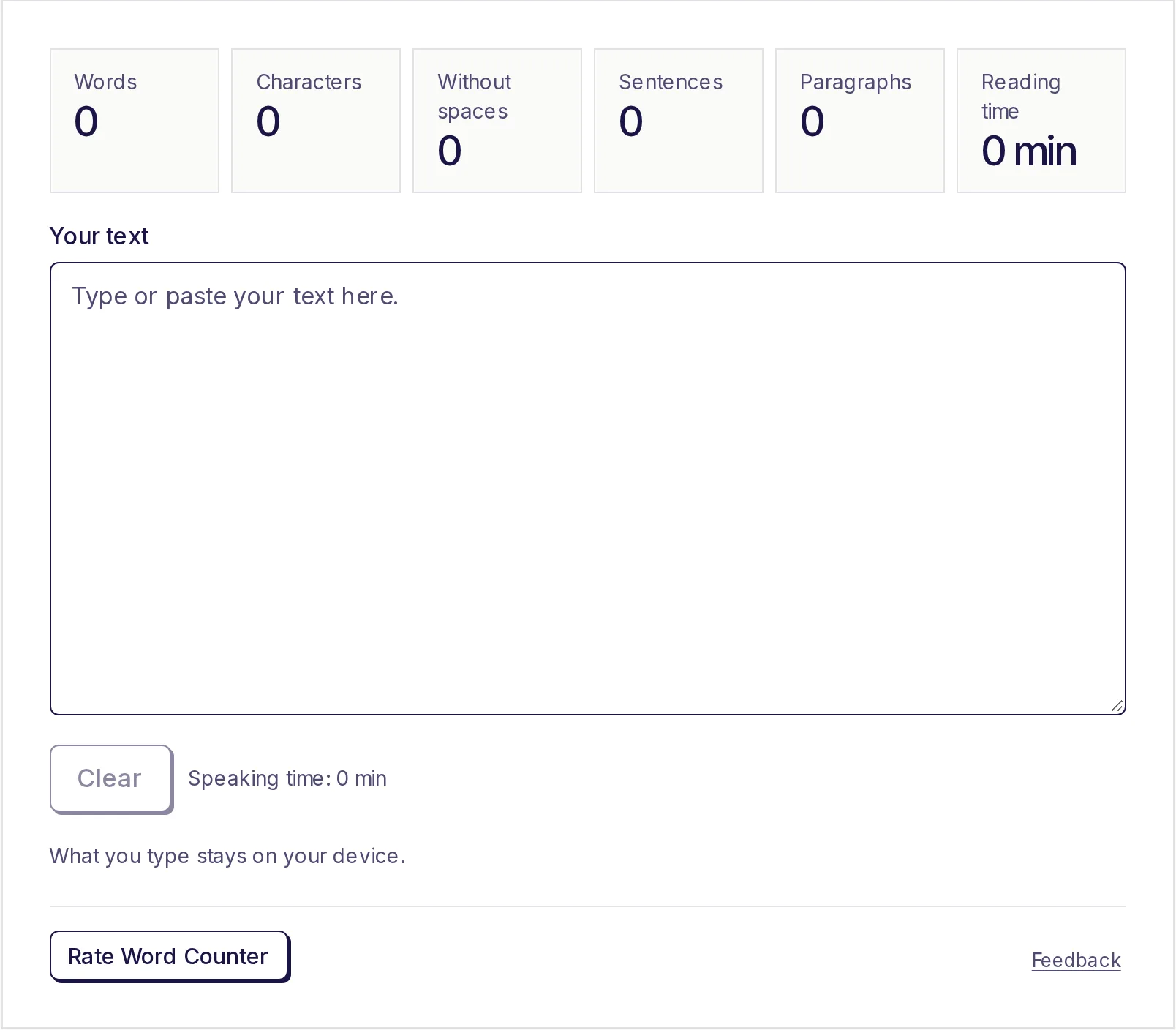
Turn on Show tokens to see exactly where the text is split; it's the quickest way to see why a word is expensive. Everything is counted on your device. If your limit is in words rather than tokens, the free word counter also shows reading and speaking time.
Convert tokens to words now
Paste your text into the free AI token counter and read the words and tokens together. It's free, works in your browser, and nothing you paste is sent anywhere.
Frequently asked questions
- How many words is 1,000 tokens?
- About 750 English words on average. Simple prose can reach nearly 900; technical writing can be closer to 550.
- How many tokens is 1,000 words?
- About 1,333 tokens for typical English (1,000 ÷ 0.75). Expect more for technical text, code or other languages.
- Why does Hindi use more tokens than English?
- Tokenizers are trained mostly on English, so Hindi words are split into more pieces. Newer tokenizers are far better: one Hindi sample took 113 tokens on GPT-4o's tokenizer and 376 on GPT-4's.
- Is a token the same as a word?
- No. A token can be a whole word, part of a word, a space plus a word, or punctuation. Common short words are often one token each.
- Are Claude and Gemini tokens the same as GPT tokens?
- No. Each uses its own tokenizer, so counts differ. The counter gives exact GPT counts and estimates for Claude and Gemini.
Text tools
Try the AI Token Counter
Free, no sign-up, and your files stay on your device. Paste a prompt or document to count its tokens as you type: exact counts for GPT-5, GPT-4.1, GPT-4o and GPT-4, plus estimates for Claude and Gemini, and how much of each model's context window it fills.
Also useful
- Word CounterPaste or type your text to count words, characters (with and without spaces), sentences and paragraphs as you type, plus reading time, speaking time and your most used words. Nothing to click: the numbers update live. What you type stays on your device.
- Character CounterCount characters with and without spaces as you type, and see how many you have left for X posts, text messages, meta descriptions, Instagram bios, LinkedIn, YouTube and your own limit. Also counts spaces, letters, lines and bytes.