How to Make a Barcode Free: EAN, UPC and Code 128
Choose the right barcode type, make it free as a PNG or SVG with the check digit added for you, and learn why retail barcodes need a GS1 number.
Published · 5 min read
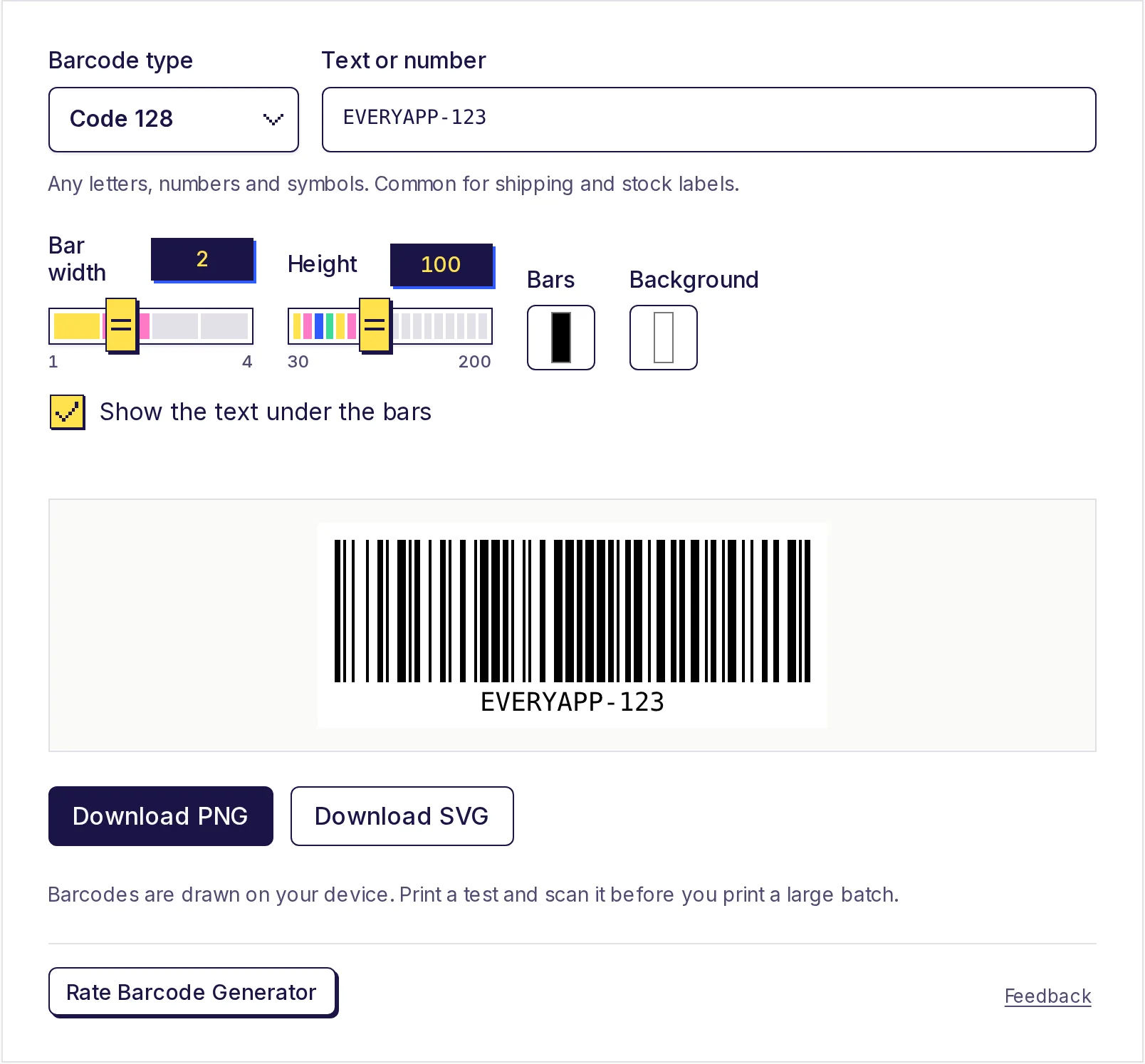
To make a barcode, choose the type, type your number or text, and download it. In the free barcode generator that's three steps: pick Code 128, EAN-13, UPC-A or another format, type the value (for EAN and UPC, the check digit is added for you), then click Download PNG or Download SVG. One catch: retail EAN and UPC numbers come from GS1, the official numbering body. The generator draws your number; it can't issue one.
Which barcode type do you need?
Picking the right type matters more than anything else. A scanner set up for retail checkout won't help if you print a type it doesn't expect.
| Type | What it holds | Typical use |
|---|---|---|
| EAN-13 | 13 digits | Retail products in most of the world, including India, Europe and Asia |
| UPC-A | 12 digits | Retail products in the US and Canada |
| EAN-8 | 8 digits | Small retail packs where EAN-13 won't fit |
| UPC-E | 8 digits | A compressed UPC for small US packages |
| Code 128 | Letters, numbers and symbols | Shipping labels, stock (SKU) labels, asset tags, internal tracking |
| Code 39 | Capital letters, numbers, a few symbols | Older industrial and ID systems |
| ITF-14 | 14 digits | Outer cartons and cases of retail products |
| Codabar | Numbers and a few symbols | Libraries, blood banks, some older systems |
The short answer: for products sold in shops, use EAN-13 (or UPC-A in North America). For everything you label yourself, such as stock in a warehouse, equipment, library books or event tickets, use Code 128.
If you want people to scan with their phones and open a link, you need a QR code instead. See the guide to making a QR code.
Retail barcodes and GS1
A barcode is just a picture of a number. The number is what matters. For retail, EAN and UPC numbers must be unique worldwide, so they're issued by GS1, a not-for-profit standards organisation with an office in each country (for example GS1 India and GS1 US). A company joins GS1, gets a company prefix, and numbers its products from it.
Large retailers and online marketplaces often require GS1-registered numbers and may check them. Buying cheap "barcode numbers" from resellers, or making one up, can get products rejected or listed under the wrong company. Rules differ between retailers and marketplaces, so check what yours asks for before you print packaging.
For internal use, such as your own stock system, you don't need GS1 at all. Use Code 128 with any SKU or code you like.
How to make a barcode
- Open the free barcode generator.
- Choose the Barcode type. A hint under the box tells you what that type accepts.
- Type your value into Text or number.
- EAN-13: type 12 digits and the 13th, the check digit, is added. Type all 13 and it's checked.
- UPC-A: type 11 digits, or all 12.
- EAN-8: type 7 digits, or all 8.
- ITF-14: type 13 digits, or all 14.
- Code 128: any standard keyboard characters, up to 80.
- Code 39: lowercase letters are changed to capitals for you.
- Adjust the look if you need to: Bar width (1 to 4), Height, the Bars and Background colours, and Show the text under the bars.
- Click Download PNG or Download SVG.
- Print a test and scan it before you print a batch.
The barcode is drawn on your device. Nothing you type is uploaded.
What's a check digit?
The last digit of an EAN, UPC or ITF-14 code is a check digit, worked out from the others so a scanner can spot a misread. Here's how it works for EAN-13 using the number 590123412345:
- From the left, multiply the digits alternately by 1 and 3: 5×1, 9×3, 0×1, 1×3, 2×1, 3×3, 4×1, 1×3, 2×1, 3×3, 4×1, 5×3.
- Add them up: 5 + 27 + 0 + 3 + 2 + 9 + 4 + 3 + 2 + 9 + 4 + 15 = 83.
- Find what you need to add to reach the next multiple of 10: 90 − 83 = 7.
So the full code is 5901234123457. If you type a 13-digit code with the wrong last digit, the generator tells you what it should be. That catches most typing mistakes before they reach a printed label.
PNG or SVG?
- SVG is made of shapes, not pixels, so it stays perfectly sharp at any size. Use it for packaging artwork, label design software and anything going to a professional printer.
- PNG works everywhere: Word, Google Docs, label printer apps and spreadsheets. It's drawn at four times the on-screen size, so it prints crisply at normal label sizes.
Printing tips
- Keep black bars on a white background. Scanners read contrast. Red bars, or bars on a dark or patterned background, often fail. If you change the colours, keep the bars dark and the background light.
- Leave white space on both sides. The generator adds a margin; don't let other artwork crowd it.
- Don't squash it. Stretch or shrink both width and height together. Changing only one can make the bars unreadable.
- Don't print too small. Retail codes have recommended sizes; very small codes may not scan at checkout. Check your printer or retailer's guidance.
- Test with the scanner you'll actually use, whether that's a handheld scanner, a till, or a phone app.
Make yours now
Choose the type, type your code and download a sharp PNG or SVG. The free barcode generator works on your device, and the barcodes are yours to use however you like.
Frequently asked questions
- Can I get a barcode number for my product here?
- No. Retail EAN and UPC numbers are issued by GS1. The generator draws a barcode for a number you already have, and adds or checks the check digit.
- Which barcode should I use for my small business?
- For products sold through shops or marketplaces, EAN-13 (or UPC-A in the US and Canada) with a GS1 number. For your own stock labels and shipping, Code 128 with your own SKU codes.
- What is the difference between a barcode and a QR code?
- A standard barcode holds a short number or code in one row of bars, and is read by shop and warehouse scanners. A QR code is a square pattern that can hold a whole link or text and is easy to scan with a phone.
- Why won't my barcode scan?
- Common causes are low contrast, coloured bars, no white space around the code, a squashed image, or printing too small. Print a test with black bars on white and try again.
- Can I use the barcodes commercially?
- Yes. The barcodes you make are yours to use however you like, on products, labels and packaging.
Generators
Try the Barcode Generator
Free, no sign-up, works in your browser. Make a barcode in seconds and download it as a sharp PNG or SVG: Code 128, EAN-13, EAN-8, UPC-A, UPC-E, Code 39, ITF-14 or Codabar.